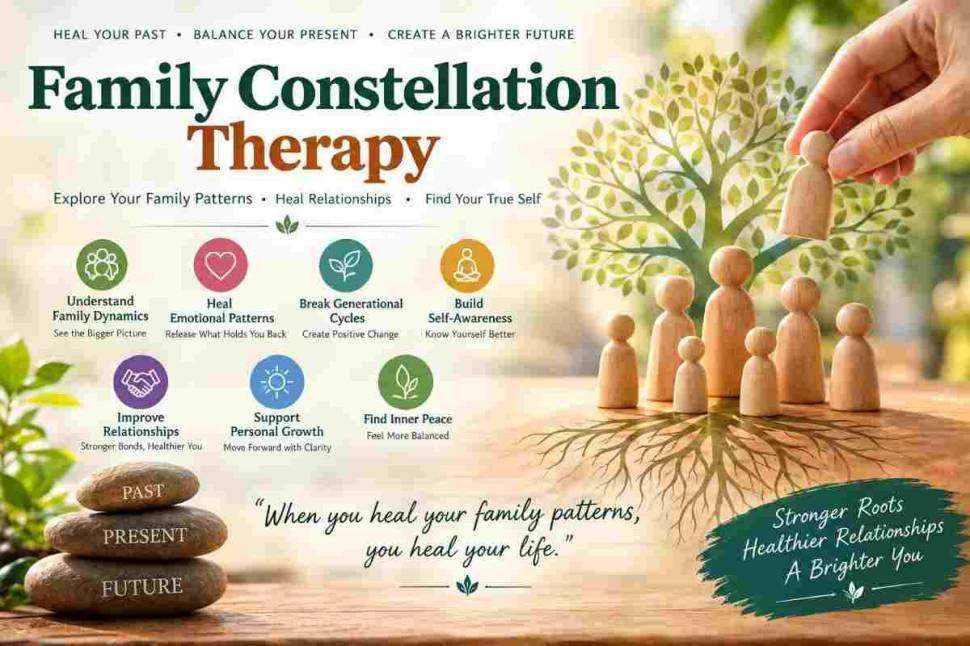
Family relationships can have a meaningful influence on how people communicate, respond to conflict, understand themselves, and experience connection with others. Sometimes, however, certain relationship patterns can be difficult to understand. Family Constellation Therapy is an experiential approach that explores relationships within a family or wider social system and looks at how people experience their place within that system.
Rather than focusing only on one individual, family constellation work considers the person's relationships and the broader family context. It may help participants reflect on recurring relationship patterns, unresolved feelings, family roles, and connections between different generations.
For anyone considering this approach, it is important to understand what family constellation therapy involves, what it may be used for, and what the current evidence says about it.
What Is Family Constellation Therapy?
Family Constellation Therapy, also called Family Systemic Constellation, is a short-term experiential approach that aims to help people explore difficult experiences within a social or family system.
A systematic review published in Family Process described family/systemic constellation therapy as a group intervention intended to help participants better understand and potentially change conflictive experiences within a social system such as a family. The review found some encouraging results, but also noted that the overall quantity and quality of available evidence was low.
The approach commonly focuses on relationships rather than viewing a concern entirely as an individual problem.
How Does Family Constellation Therapy Explore Family Relationships?
1. It Looks at the Family as a System
Families are interconnected systems. A change involving one person can sometimes affect how other family members communicate and behave.
Family constellation work explores these connections by looking at the roles, relationships, and experiences that exist within the family system. This can help participants consider their concerns from a broader perspective rather than focusing only on one relationship or event.
2. It Explores Recurring Relationship Patterns
Some families experience recurring patterns such as frequent misunderstandings, emotional distance, conflict, or difficulties communicating.
A constellation session may provide an opportunity to explore these patterns in a structured setting. The purpose is not necessarily to assign blame, but to encourage reflection about how relationships are experienced and how different family members may perceive the same situation.
3. It Encourages a Different Perspective
One feature of constellation work is the use of experiential exercises or representations of people and relationships.
Participants may explore how they perceive their connection with family members and how changes in positioning or perspective affect their experience. This can sometimes make relationship patterns easier to discuss than through ordinary conversation alone.
4. It Examines Family Roles
People often develop particular roles within their families. Someone may see themselves as the responsible child, mediator, caretaker, supporter, or independent member of the family.
Family constellation work can encourage reflection on whether these roles still feel appropriate or whether they influence current relationships.
Understanding a family role does not mean that the role is objectively correct or that it determines a person's future. Instead, it can provide a framework for exploring personal experiences.
5. It Can Explore Intergenerational Experiences
Family constellation approaches sometimes consider experiences across generations. Practitioners may explore how major family events, losses, separation, conflict, or other experiences are perceived as influencing current family relationships.
These interpretations should be approached carefully. A person's current emotions or difficulties should not automatically be attributed to an event in a previous generation without appropriate evidence.
What Can Family Constellation Therapy Help People Explore?
People may consider family constellation work for different relationship-related concerns, including:
- Communication difficulties
- Repeated family conflicts
- Emotional distance between family members
- Difficult family roles
- Relationship patterns
- Feelings surrounding separation or loss
- Challenges involving belonging and connection
- Personal concerns connected with family experiences
The goal can vary from person to person. Some people may be looking for greater self-understanding, while others may want to examine a particular family relationship or recurring pattern.
Can Family Constellation Therapy Improve Family Relationships?
Research provides some evidence of potential benefits, but it is important not to overstate the findings.
A 2021 systematic review identified 12 eligible studies involving 568 participants. Nine studies reported statistically significant improvements after the intervention, and a meta-analysis of five studies found a moderate effect for general psychopathology. However, the researchers emphasized that the evidence base was relatively small and its overall quality was low.
A later study involving 102 participants reported improvements across many measured outcomes, including interpersonal quality of life, general wellbeing, and psychological symptoms, with many improvements still observed at six months.
A 2024 randomized controlled trial also reported some improvements following a pandemic-adjusted version of the intervention, but the researchers noted that improvements were small and mostly disappeared by six months. The study's modifications also limited how broadly its results could be applied to other forms of family constellation work.
Therefore, family constellation therapy may be useful for some people as a reflective or therapeutic approach, but it should not be presented as a guaranteed solution for family problems.
Family Constellation Therapy and Self-Understanding
Family relationships can influence the way people understand their responsibilities, boundaries, communication habits, and emotional responses.
A guided constellation exercise may encourage questions such as:
- What role do I usually take in my family?
- How do I respond when family conflict occurs?
- Do I find it difficult to express my needs?
- What relationship patterns do I notice repeatedly?
- How do I understand my connection with other family members?
- What boundaries might be helpful in my relationships?
These questions can support self-reflection regardless of whether someone accepts the theoretical assumptions behind constellation work.
What Happens During a Family Constellation Session?
The exact format varies according to the practitioner.
In some settings, family constellation work takes place in a group. A participant brings a particular concern, and the facilitator may ask them to represent family members or aspects of the family system using people, objects, or other forms of representation.
The facilitator then guides an experiential exploration of the relationships and perspectives involved.
Because different practitioners use different methods, anyone considering a session should ask about the facilitator's training, the structure of the session, confidentiality, and what to expect before participating.
Is Family Constellation Therapy Scientifically Proven?
Family constellation therapy has been studied, but the evidence remains developing.
The available research includes systematic reviews and controlled studies reporting potentially positive outcomes. At the same time, researchers have highlighted limitations involving the number of studies, study quality, intervention variations, and the need for more rigorous research.
For this reason, it is more accurate to describe family constellation therapy as an approach that some people use for exploring relationships and personal experiences rather than claiming that it is a universally proven treatment.
Choosing a Family Constellation Practitioner
If you are considering family constellation services, look for a practitioner who communicates clearly about their qualifications, approach, confidentiality, and the limits of the method.
A responsible practitioner should not pressure you to accept a particular interpretation of your family history. You should also feel comfortable stopping or discussing any exercise that causes significant distress.
For serious mental-health concerns, family constellation work should not replace appropriate care from a qualified mental-health professional.
How Maarwallkkarma Can Support Your Exploration
Maarwallkkarma provides spiritual and personal-development services, including services related to family and personal wellbeing. If you are interested in exploring family relationships through a constellation-based approach, you can learn about the service and discuss your concerns before deciding whether it is appropriate for you.
The purpose of a session should be to create space for reflection, understanding, and constructive exploration of relationships rather than to assign blame or make unsupported claims about family members.
Conclusion
Family Constellation Therapy offers an experiential way to explore family relationships, roles, communication patterns, and personal experiences within a wider family system. By looking at relationships from different perspectives, some people may gain new ways of reflecting on recurring patterns and interpersonal concerns.
Research has reported promising findings in some studies, particularly around psychological wellbeing and interpersonal outcomes, but the evidence remains limited.
For people interested in this approach, the most useful starting point is an informed conversation with a qualified practitioner. Family relationships are complex, and meaningful change may involve reflection, communication, professional support, and practical steps alongside any therapeutic or experiential approach.